Why is My Business Disappearing from the Local Map Pack?
The 2026 local search landscape has been fundamentally reshaped by what industry experts call the "Proximity Filter," a refinement of Google’s neural matching algorithms that prioritizes hyper-local relevance over traditional ranking signals. For many businesses, this has resulted in a "shrinking radius," where they appear in the Local Pack for users a block away but vanish for users just two miles out.
Quick Answer: What is the 2026 Proximity Filter?
The 2026 Proximity Filter is a Google algorithm update that weights physical distance as the primary ranking factor for the Google Business Profile (GBP) Map Pack. It aims to provide users with the most immediate, accessible solutions by filtering out businesses that are geographically distant, even if they have higher review counts or traditional SEO authority.
Why is My Business Disappearing from the Local Map Pack?
The primary reason businesses disappear from the Map Pack is spatial overshadowing, where Google’s AI determines that closer competitors provide a more "frictionless" user experience regardless of brand strength. In 2026, Google has moved beyond simple "near me" searches to predictive proximity, using real-time traffic data and user movement patterns to decide which three businesses earn the Map Pack spots.
Is proximity more important than reviews in 2026?
Yes, in many high-competition service categories, proximity now acts as a "binary gatekeeper" that supersedes review velocity. While a business with 500 reviews would previously outrank a closer business with 50 reviews, the 2026 filter often hides the distant high-authority profile to prioritize the immediate physical neighbor. This ensures that mobile users receive results they can reach within minutes.
How does "Centroid Bias" affect my ranking?
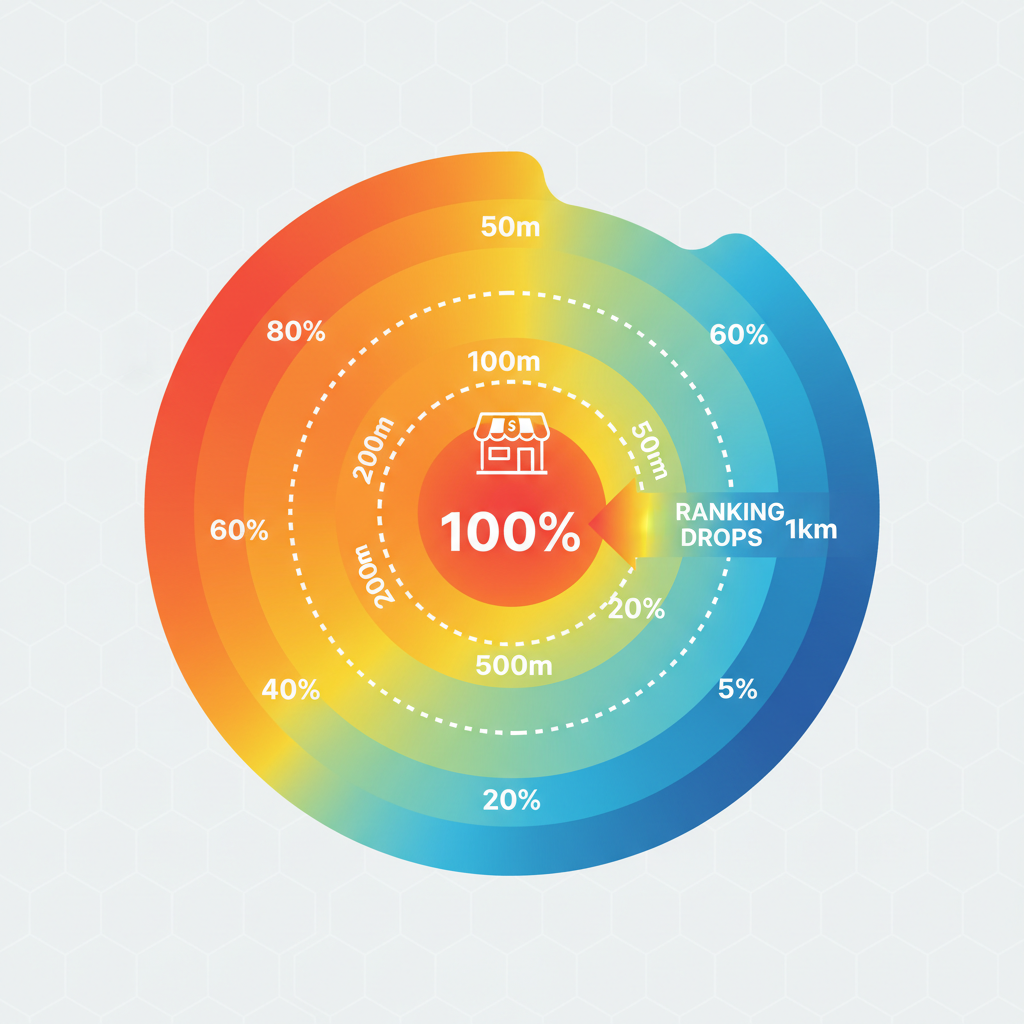
Centroid Bias refers to Google’s tendency to favor businesses located near the geographic center of a city or a recognized neighborhood hub. At INFINI Marketing, we have observed that businesses located on the fringes of municipal boundaries face a 40-60% reduction in visibility compared to those within a 1-mile radius of the "city center" coordinates defined by Google Maps.
📉 Visibility Decay by Distance (2026 Estimates)
How to Fix Local Proximity Issues and Reclaim Your Radius
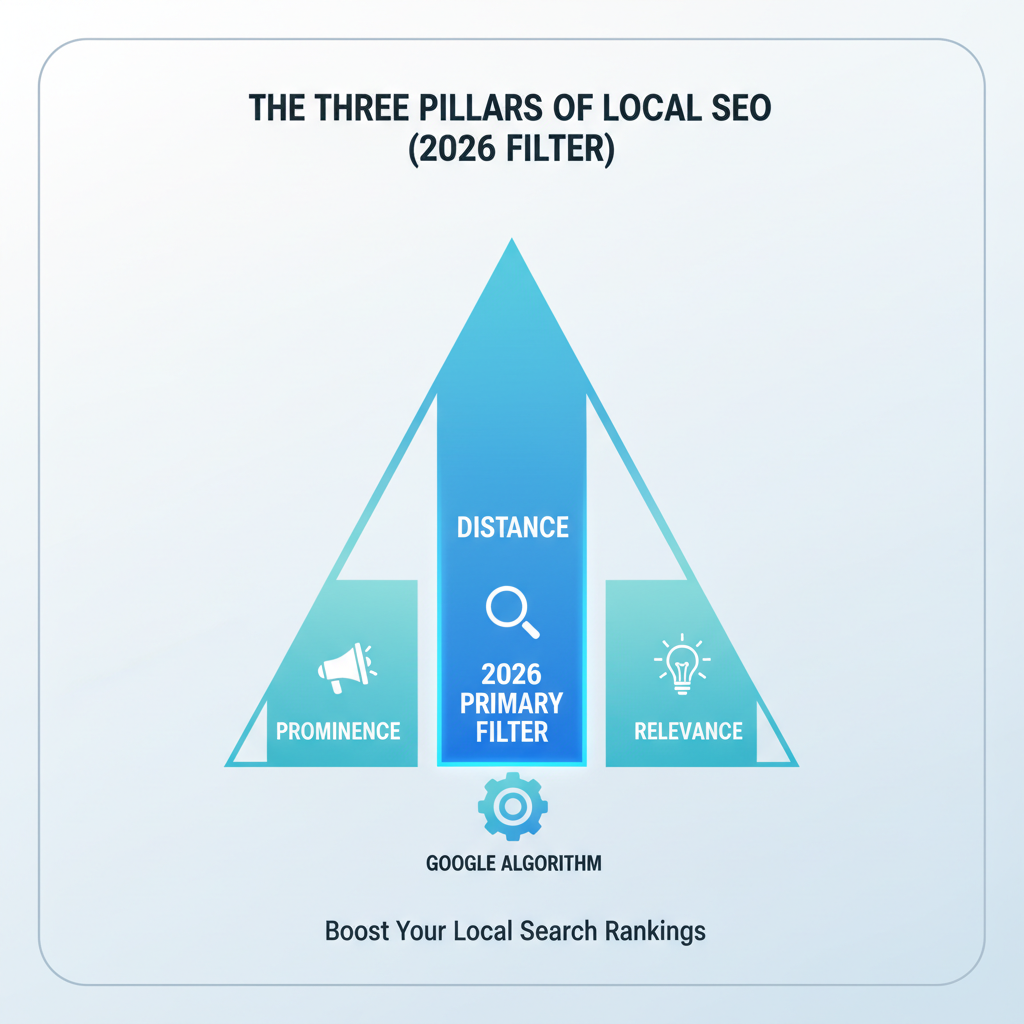
Fixing local proximity issues requires a shift from "city-wide SEO" to "neighborhood-node optimization." Since you cannot move your building, you must signal to Google that your "Relevance" and "Prominence" are so high that they override the physical "Distance" penalty—the three pillars of Google’s Local Ranking criteria.
Step 1: Implement Hyper-Local Content Silos
To combat the GBP proximity filter 2026, you must create web pages dedicated to specific intersections, landmarks, and micro-neighborhoods surrounding your location. This signals to Google’s AI that your service area is dense and specific. Instead of targeting "Houston Plumber," target "Plumber near Memorial Park" or "Emergency Pipe Repair in River Oaks."
Step 2: Utilize "Geotagged Proof" via Mobile Interactions
Google now monitors "Store Quality Signals," including how often users’ GPS coordinates stop at your location after a search. Encouraging customers to interact with your GBP—such as checking in or uploading photos while physically on-site—strengthens the geographic tie between your digital profile and your physical coordinates.
Step 3: Audit for "Address Crowding"
If your business shares a building or a 100-foot radius with a competitor in the same primary category, Google may "filter" one of you out to provide variety. In practice, we advocate for refining your Primary Category to a more niche selection (e.g., changing "Lawyer" to "Personal Injury Attorney") to bypass the proximity filter through specificity.
💡 Tip
Standard Operating Procedure: Run a "Local Grid Search" using a tool like BrightLocal or WhiteSpark. If you see a "hard edge" where your rankings go from #1 to #20 instantly, you are being hit by a proximity filter rather than a lack of authority.
What are the Advanced Local SEO Radius Optimization Strategies?
Local SEO radius optimization in 2026 involves using technical transparency and "Local Inventory" signals to prove you are the most relevant choice for the user's specific intent.
How do "Entity Connections" help expand ranking radius?
An Entity Connection is established when your business is mentioned alongside local landmarks, transit hubs, or community events in authoritative local digital publications. By associating your business "entity" with the broader neighborhood infrastructure, you convince the algorithm that your reach extends naturally beyond your front door.
Why is "Signal Consistency" more critical than ever?
Inconsistent Name, Address, and Phone (NAP) data now triggers a proximity "penalty" because Google lacks the confidence to recommend your location to a user in transit.
"In 2026, data confidence is the new PageRank. If Google's 'Trust Engine' sees even a 5% variance in your location data across the web, it will default to a competitor with a verified, stable footprint." — INFINI Marketing Technical Analysis.
📊 Impact of Data Consistency on Reach
Summary of Key Takeaways
Distance is the New King: The 2026 Proximity Filter prioritizes the user's immediate physical location above almost all other factors.
The "Filter" is Dynamic: Your visibility changes based on time of day, traffic patterns, and the density of competitors.
Hyper-Localization is the Cure: To fix proximity issues, move away from broad city keywords and toward micro-neighborhood "nodes."
Interaction Matters: Real-world GPS signals (customers visiting your store) are now high-authority ranking factors.
- Hits: 257
