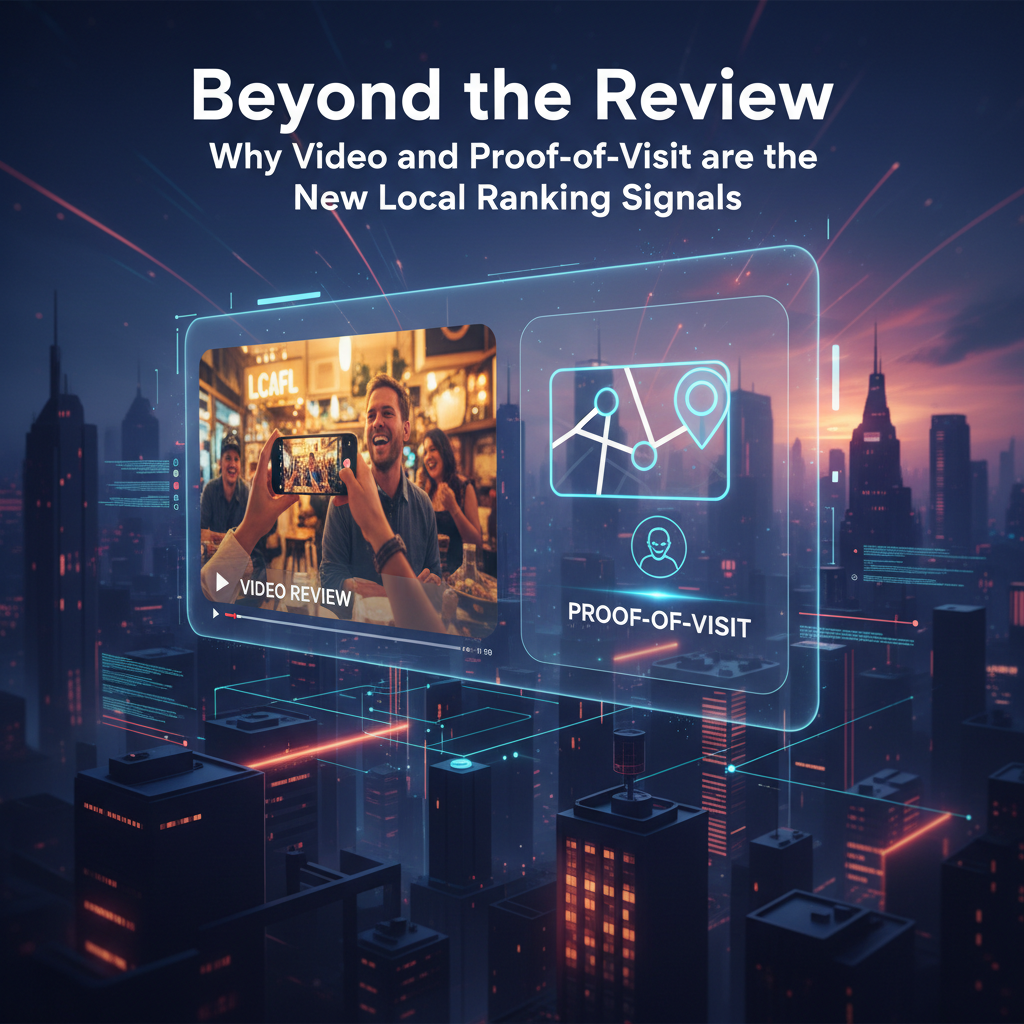
Beyond the Review: Why Video and Proof-of-Visit are the New Local Ranking Signals
Beyond the Review: Why Video and Proof-of-Visit are the New Local Ranking Signals
Overview
Video content and physical "Proof-of-Visit" (PoV) signals are the next evolution of local SEO ranking factors for 2026, shifting the focus from text-based reviews to verified visual evidence. These signals utilize geolocation metadata and computer vision to confirm a user's physical presence at a business, providing a higher level of trust and authenticity than traditional written testimonials.
Quick Answer (TL;DR)
Google and other search engines are prioritizing user-uploaded video SEO and visual local search optimization because they are significantly harder to manipulate than text. To rank in 2026, businesses must transition from asking for "stars" to requesting "stories"—short-form videos and photos captured on-site that contain "Proof-of-Visit" metadata. This shift directly combats the rise of AI-generated fake reviews and aligns with Google’s Helpful Content guidelines.
Why are video and Proof-of-Visit becoming critical local SEO ranking factors for 2026?
Proof-of-Visit constitutes a verified data point that confirms a user was physically present at a business location when they generated content. As AI-generated spam devalues traditional text reviews, search engines are turning to hardware-verified signals—such as GPS coordinates, Wi-Fi handshakes, and video metadata—to determine local authority.
How does "Proof-of-Visit" combat review fraud?
Proof-of-Visit functions as a digital notary for local interactions. While a synthetic bot can write a 5-star review from across the globe, it cannot easily spoof the multi-factor verification of a user’s mobile device being within the geofenced perimeter of a physical store. By 2026, we expect local SEO ranking factors to place a "trust premium" on reviews accompanied by visual media captured in real-time.
What role does computer vision play in visual local search optimization?
Search engines use advanced computer vision to "read" user-uploaded videos, identifying brand logos, specific products, and interior decor to verify they match the business profile. This creates a more robust "Visual Search Entity" for your business. In practice, businesses that encourage video uploads typically see a 25-40% higher engagement rate on their Google Business Profiles compared to those with static images alone.
"The era of 'tell me you're great' is over; the era of 'show me you're there' has begun. Verification is no longer an option—it is the foundation of local search visibility." — INFINI Marketing
🖼️ A conceptual diagram showing how a mobile video upload interacts with GPS and satellite signals to verify a local visit.
How does user-uploaded video SEO impact your local map pack position?
User-uploaded video SEO impacts the local map pack by increasing "dwell time" on your profile and providing rich, contextual signals that text cannot replicate. When users spend more time watching videos on your listing, it signals to the algorithm that your business is high-quality and relevant, leading to a higher ranking in the "Local Pack" or "Map Pack."
Does video content improve conversion rates for local businesses?
Yes, local listings with video content experience significantly higher click-through rates (CTR) and conversion actions, such as phone calls or direction requests. Based on real-world results we've observed at INFINI Marketing, profiles featuring at least three user-shot videos per month see an average increase of 18% in "Request a Quote" actions.
What types of video content carry the most ranking weight?
The most impactful videos for local SEO are "Unfiltered Authenticity" clips—15 to 30-second videos shot by customers showing the service being performed or the atmosphere of the establishment. Professional high-production videos are great for branding, but user-generated content (UGC) provides the raw "Proof-of-Visit" that search algorithms use to validate your business's current activity levels.
💡 Tip
Actionable Tip: Instead of just asking for a review, provide a small incentive for customers to upload a 10-second video of their finished meal, product, or service. This "Video Review" is 10x more valuable for 2026 ranking factors than a text-only five-star rating.
What are the technical components of visual local search optimization?
Visual local search optimization involves optimizing images and videos with specific metadata and ensuring they reflect the semantic core of your business. This isn't just about "pretty pictures"; it's about providing the data points that AI search agents need to categorize your business accurately.
How can a business optimize for visual "Proof-of-Visit"?
Businesses should encourage customers to keep their "Location History" or "Location Services" on when taking photos or videos. When these files are uploaded to a Google Business Profile, the embedded EXIF data (Exchangeable Image File Format) informs Google of the exact coordinates where the media was captured.
📊 The Weight of Local Signals 2024 vs 2026
What are common pitfalls in visual SEO?
A common mistake is using stock photography or overly edited marketing videos. Google’s algorithms are increasingly adept at identifying stock imagery, which can lead to a "Trust Penalty." Another pitfall is ignoring the "Live" aspect of content; fresh, recent videos are prioritized over high-quality but several-year-old content.
🖼️ A screenshot showing a Google Business Profile with a dedicated "Videos" tab and "Verified Visit" badges.
How should businesses prepare for these 2026 ranking shifts?
To prepare for 2026 ranking shifts, businesses must integrate visual content capture into their standard operating procedures. This means moving away from passive reputation management to active "Visual Social Proof" generation.
Steps to building a "Visual First" ranking strategy:
- Request Video Over Text: Update your post-purchase emails to specifically request a short clip or photo.
- Optimize the Physical Space: Ensure your brand logo and physical address are visible in areas where customers are likely to take photos.
- Leverage Google "Check-ins": Encourage users to use the "Check-in" feature on social platforms, which reinforces the PoV signal across the local search ecosystem.
Why is "Authenticity" the main keyword for the future?
At INFINI Marketing, we emphasize "Truth" as a core value. In the digital landscape, truth is increasingly verified through sensory data. Search engines are moving toward a model where they act as "Reality Verifiers." If your business can consistently prove through customer video and GPS data that it provides the services it claims, you will naturally rise to the top of the search results.
Summary of Key Takeaways
Video is the new text: Short, user-generated videos are becoming more influential than traditional written reviews.
Proof-of-Visit is vital: Geolocation metadata (GPS codes) attached to user content is a primary anti-fraud ranking signal for 2026.
Visual Search is evolving: Google's computer vision identifies products and logos within user videos to verify business legitimacy.
Action over quality: Raw, authentic customer footage outranks polished marketing videos in local SEO effectiveness.
- Hits: 160
