Case Study: How AI-Driven Lead Scoring Scaled a Houston Tech Firm’s Revenue by 40%
This case study examines how a Houston-based managed IT services provider leveraged AI-driven lead scoring to optimize their sales funnel and achieve a 40% increase in annual recurring revenue (ARR). By transitioning from manual lead qualification to predictive analytics, the firm successfully identified high-value prospects with greater precision and shortened their sales cycle by 22%.
How does AI-driven lead scoring impact revenue growth?
AI-driven lead scoring increases revenue by prioritizing prospects most likely to convert, allowing sales teams to focus their resources on high-probability opportunities. In practice, this technology moves beyond traditional "point-based" scoring—which often relies on arbitrary markers like whitepaper downloads—and instead uses machine learning to analyze thousands of data points from historical conversions.
What is the role of predictive analytics lead gen in Houston’s tech sector?
Predictive analytics in lead generation uses historical CRM data and third-party intent signals to calculate a "propensity to buy" score for every contact in a database. For Houston tech firms, this often involves integrating regional economic data and industry-specific triggers, such as a company's recent cloud migration or a sudden increase in cybersecurity searches.
Why is CRM data optimization essential for AI success?
AI models are only as effective as the data they consume; therefore, CRM data optimization is the process of cleaning, enriching, and standardizing lead records to ensure model accuracy. At INFINI Marketing, we have found that firms with fragmented or "dirty" data typically see a 50% lower ROI on AI implementations compared to those who invest in data hygiene first.
📉 Lead Conversion Rate Growth: Manual vs. AI Scoring
How did this Houston tech firm implement AI marketing automation?
The firm implemented AI marketing automation by integrating a predictive scoring layer directly into their existing HubSpot CRM, replacing their subjective "BANT" (Budget, Authority, Need, Timeline) manual checks. This allowed the system to automatically route leads with a score above 85/100 to the senior account executives, while leads with lower scores were placed in automated nurture sequences.
What were the three phases of the implementation?
- 1 Data Auditing: The team audited three years of historical sales data to identify the attributes of "closed-won" vs. "closed-lost" deals.
- 2 Model Training: Using AI marketing automation tools, they trained a model to recognize patterns such as specific job titles combined with recent website engagement and company size.
- 3 Real-Time Processing: The system was set to score new leads in real-time, reducing the "lead-to-call" time from 4 hours to under 10 minutes.
How did the firm manage the transition in Texas?
In the Texas tech market, where relationship-based selling is prominent, the firm used AI not to replace the human element but to empower it. Sales reps received "AI Insights" alongside each lead, explaining why a lead was scored highly (e.g., "This company just opened a new branch office, increasing their need for managed IT").
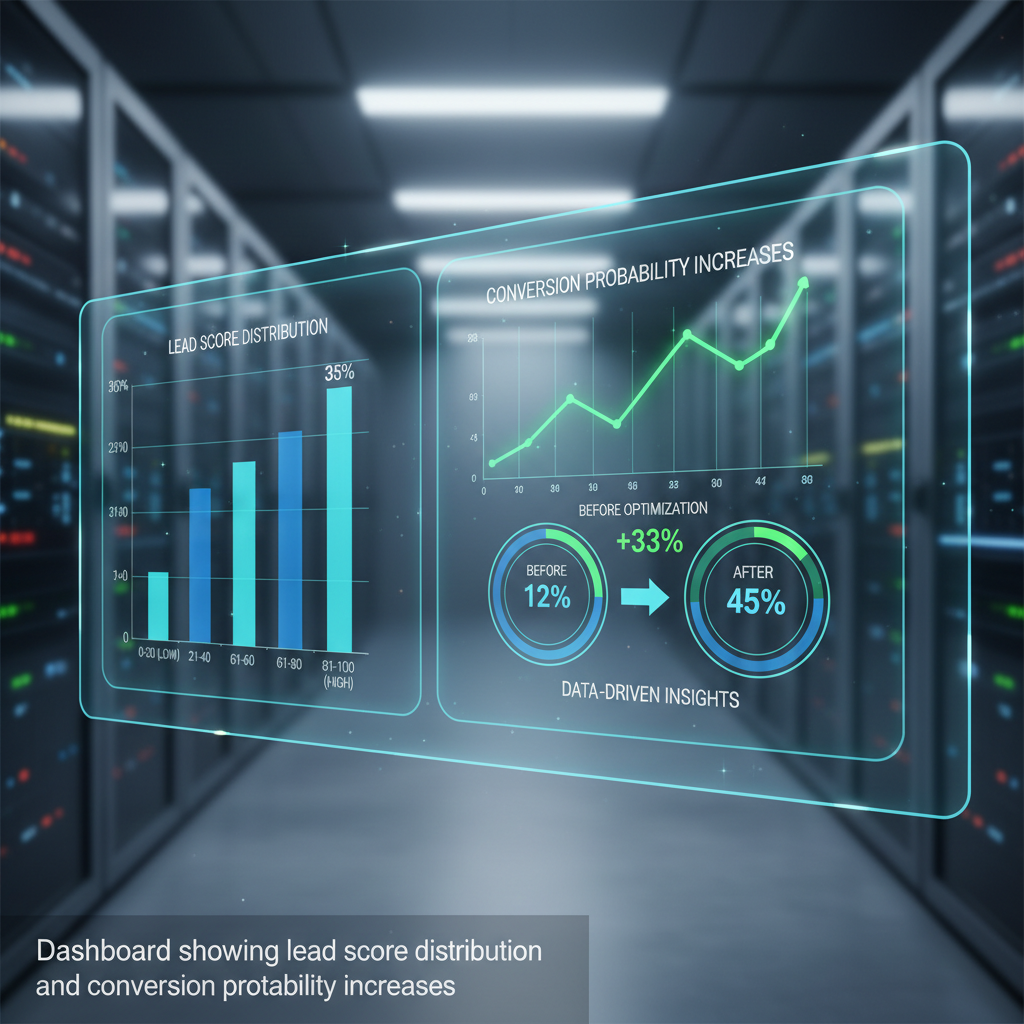
What specific metrics demonstrate the project’s success?
The primary metric of success was a 40% year-over-year revenue increase, driven by a 35% improvement in the lead-to-opportunity conversion rate. By focusing on quality over quantity, the sales team was able to handle a higher volume of qualified deals without increasing headcount.
"The shift from guessing which leads were 'hot' to knowing which ones were 'ready' fundamentally changed our culture. We stopped chasing ghosts and started closing partners." — CEO of the Houston Tech Firm.
How did the sales cycle duration change?
The sales cycle decreased from an average of 115 days to 90 days. Because the AI identified leads that were already deep in the "consideration" phase of the buyer's journey, the initial sales conversations were more strategic and less educational.
What happened to the ROI on marketing spend?
Marketing ROI increased by 55% as the firm's advertising budget was reallocated. By seeing which channels produced the highest-scoring leads (using predictive analytics lead gen), the marketing team cut spending on low-performing social channels and doubled down on high-intent search terms and LinkedIn targeting.
ℹ️ Info
Key Observation: One of the most significant discoverable traits in this case was that "silent" leads—those who didn't download content but visited the pricing page multiple times—were often 3x more valuable than those who downloaded multiple top-of-funnel ebooks.
What are the common pitfalls in AI lead scoring?
The most common pitfall is "model drift," where the AI continues to score leads based on outdated market conditions or product offerings. To maintain a 40% revenue growth trajectory, firms must regularly retrain their models to reflect changes in buyer behavior and the competitive landscape.
Can AI lead scoring work for small businesses?
Yes, AI lead scoring is scalable, but small businesses must have a minimum threshold of historical data—typically at least 500-1,000 closed records—for the machine learning model to be statistically significant. For smaller datasets, "heuristic" scoring (rules-based) is a better starting point before moving to full AI automation.
Why do some Houston firms fail with AI marketing automation?
Failure usually stems from a lack of "Sales and Marketing Alignment." If the sales team does not trust the AI scores, they will ignore high-scoring leads in favor of their own intuition. Building trust requires transparency in how the score is calculated and consistent feedback loops between the two departments.
Summary of Key Takeaways
Precision Over Volume: Success in modern lead gen isn't about getting more leads; it's about identifying the right leads faster.
Data is Fuel: CRM data optimization is a prerequisite, not an option, for AI-driven growth.
Time Kills Deals: AI's ability to provide real-time scoring allows Houston firms to respond to high-intent prospects before the competition.
Human-AI Synergy: Technology provides the data, but the sales team provides the relationship; the two must work in tandem.

- Hits: 256
